Seals
References
Arso Civil, M., Smout, S.C., Duck, C., Morris, C., Cummings, C., Langley, I., Law, A., Morton, C., Brownlow, A., Davison, N., Doeschate, M., Lacaze, J-P., McConnell, B., and Hall, A.J. (2018). Harbour Seal Decline –vital rates and drivers. Report to Scottish Government HSD2. Sea Mammal Research Unit, University of St Andrews, pp. 63. Available here. (Accessed: 25.11.19)
Bowen, D. (2016). Halichoerus grypus. The IUCN Red List of Threatened Species 2016: e.T9660A45226042. Available here. (Accessed: 25.11.19)
Hall, A.J. & Thomas, G.O. (2007). Polychlorinated biphenyls, DDT, polybrominated diphenyl ethers and organic pesticides in United Kingdom harbor seals – mixed exposures and thyroid homeostasis. Environmental Toxicology Chemistry, 26(5), 851- 861.
Joint Nature Conservation Committee and Department of Environment, Food and Rural Affairs (on behalf of the Four Countries’ Biodiversity Group). (2012). UK Post-2010 Biodiversity Framework. Available here. (Accessed: 07.07.18)
Joint Nature Conservation Committee (2007). Report on the Species and Habitat Review (UK BAP) Available here. (Accessed: 07.03.18)
Joint Nature Conservation Committee (2007). UK Biodiversity Action Plan Priority Marine Species. Available here. (Accessed: 07.03.18)
Joint Nature Conservation Committee (1994). UK Biodiversity Action Plan. Available here. (Accessed: 27.11.19)
Lowry, L. (2016). Phoca vitulina. The IUCN Red List of Threatened Species 2016: e.T17013A45229114. Available here. (Accessed: 25.11.19)
Marine Life Information Network (n.d.). Species listed as Features of Conservation Interest (FOCI). Available here. (Accessed: 14.05.20)
Marine Life Information Network (n.d.). Species listed as ‘species of principal importance’. Available here. (Accessed: 14.05.20)
Marine Management Organisation. (n.d.). Marine Planning Evidence Base. Available here. (Accessed: 14.05.18)
Marine Scotland (n.d.). Scotland’s National Marine Plan Interactive. Available here. (Accessed: 06.08.19)
Marine Scotland (2014). Guidance on the Offence of Harassment at Seal Haul-out Sites. Available here. (Accessed: 12.11.19)
Mills, F., Sheridan, S. and Brown S., (2017). Clyde Marine Region Assessment. Clyde Marine Planning Partnership. pp 231, Available here. (Accessed: 14.05.18)
NatureScot (2020). Priority Marine Features in Scotland’s Seas. Available here. (Accessed: 04.05.21)
NatureScot (2020). Scottish Biodiversity List. Available here. (Accessed: 04.05.21)
Scottish Government (2014). Guidance on Haul-Outs. Available here. (Accessed: 09.01.20)
Scottish Marine Animal Stranding Scheme (n.d.). Interactive map database of Strandings. Available here. (Accessed: 17.12.19)
Sea Mammal Research Unit (2018). Special Committee on Seals, Scientific Advice on Matters Related to the Management of Seal Populations: 2018. Available here. (Accessed: 11.11.19)
Sea Mammal Research Unit Reports (n.d.). Available here. (Accessed: 13.06.18)
Solway Firth Partnership (1996). The Solway Firth Review, Solway Firth Partnership, Dumfries. Available here. (Accessed: 23.07.19)
South West Scotland Environment Information Centre (n.d.). Marine Mammals. Available here. (Accessed: 11.11.19)
UK National Ecosystem Assessment (2011). The UK National Ecosystem Assessment Technical Report. UNEP-WCMC, Cambridge. Available here. (Accessed: 28.05.18)
In-Text References;
Baxter, J.M., Boyd, I.L., Cox, M., Donald, A.E., Malcolm, S.J., Miles, H., Miller, B., Moffat, C.F., (Editors), (2011). Scotland’s Marine Atlas: Information for the national marine plan. Marine Scotland, Edinburgh. pp 191. Available here. (Accessed: 22.07.19)
Brownlow, A., Onoufriou, J., Bishop, A., Davison, N., & Thompson, D. (2016). Corkscrew seals: grey seal (Halichoerus grypus) infanticide and cannibalism may indicate the cause of spiral lacerations in seals. PloS one, 11(6), e0156464. Available here. (Accessed: 26.11.19)
Department for Environment Food & Rural Affairs (2019). Marine Strategy Part One: UK updated assessment and Good Environmental Status. Available here. (Accessed: 10.01.21)
Duck, C.D. (2010). Charting Progress 2 Healthy and Biological Diverse Seas Feeder Report: Section 3.5: Seals. Published by Department for Environment Food and Rural Affairs on behalf of UKMMAS. p506-539. In: UKMMAS (2010) Charting Progress 2 Healthy and Biological Diverse Seas Feeder Report (Eds. Frost, M & Hawkridge, J). Available here. (Accessed: 27.11.19)
Duck, C.D. & Morris, C.D. (2016). Surveys of harbour and grey seals on the south-east (border to Aberlady Bay) and south-west (Sound of Jura to Solway Firth) coasts of Scotland, in Shetland, in the Moray Firth and in the Firth of Tay in August 2015. NatureScot Commissioned Report No. 929. Available here. (Accessed: 11.11.19)
Duignan, P. J., Van Bressem, M. F., Baker, J. D., Barbieri, M., Colegrove, K. M., De Guise, S., De Swart, R. L., Di Guardo, G., Dobson, A., Duprex, W. P., Early, G., Fauquier, D., Goldstein, T., Goodman, S. J., Grenfell, B., Groch, K. R., Gulland, F., Hall, A., Jensen, B. A., Lamy, K., Matassa, K., Mazzariol, S., Morris, S. M., Nielsen, O., Rotstein, D., Rowles, T. K., Saliki, J. T., Siebert, U., Waltzek, T., & Wellehan, J. F. X. (2014). Phocine distemper virus: Current knowledge and future directions. Viruses, 6(12), 5093-5134. Available here. (Accessed: 12.11.19)
Marine Scotland (2020). ‘Seal Licensing’ Marine Scotland Website. Available here. (Accessed: 12.11.20)
Marine Scotland (2019). ‘Seal Licensing’ Marine Scotland Website. Available here. (Accessed: 25.11.19)
Moffat, C., Baxter, J., Berx, B., Bosley, K., Boulcott, P., Cox, M., Cruickshank, L., Gillham, K., Haynes, V., Roberts, A., Vaughan, D., & Webster, L. (Eds.). (2020). Scotland’s Marine Assessment 2020. Scottish Government. Available here. (Accessed: 10.04.21)
National Marine Plan Interactive (2019) Data layer Number 852; ‘Marine standings data 2013 – 2018 (cetaceans, seals, sharks, turtles) (time-aware)’ with data provided by Scottish Marine Animal Strandings Scheme (SMASS). Available here. (Accessed: 16.12.19)
NatureScot (n.d.) Seals. Available here. (Accessed: 11.11.19)
Russell, D.J.F., Hastie, G.D., Thompson, D., Janik, V.M., Hammond, P.S., Scott-Hayward, L.A.S., Matthiopoulos, J., Jones, E. L. & McConnell, B. J. (2016). Avoidance of wind farms by harbour seals is limited to pile driving activities. Journal of Applied Ecology, 53, 1642-1652. Available here. (Accessed: 11.11.19)
United Kingdom Marine Monitoring & Assessment Strategy (n.d). Summary of Progress towards Good Environmental Status. Available here. (Accessed: 15.12.20)
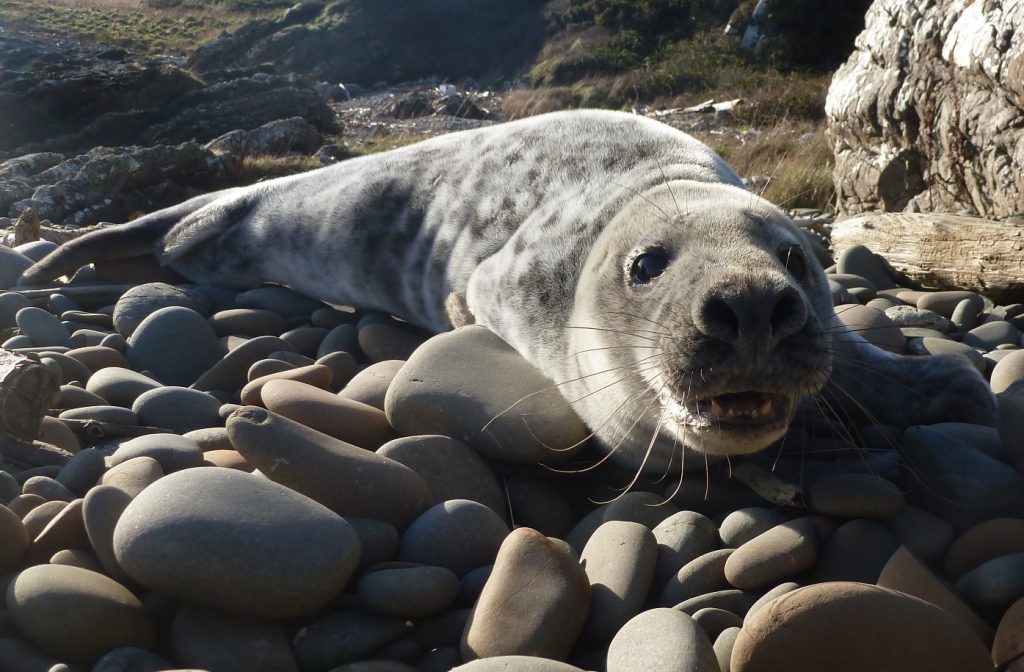
Image; Grey seal pup. © N. Coombey/ Solway Firth Partnership